Smart mattresses are becoming more widely available to answer the call for individual temperature and firmness customization. Whether you sleep with a partner with different habits, you’re susceptible to night sweats or you run cool, a smart mattress addresses pain points that most regular mattresses can’t. In my seven years as a professional product tester with expertise in the sleep category, I’ve tested around 200 different beds, including two of the most advanced models on the market: the and .
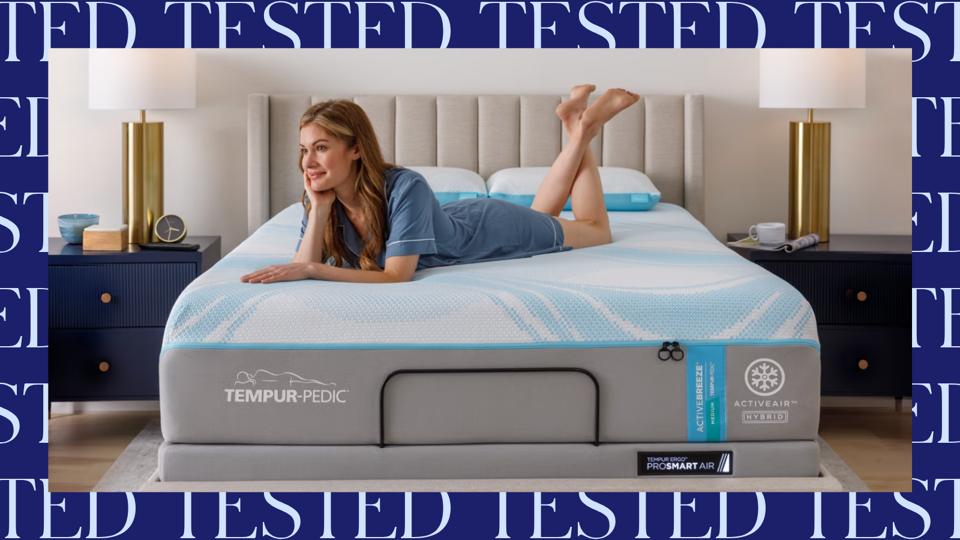
Both are perfectly capable of providing temperature relief, but each has distinct advantages that appeal to different needs. In my review, I detail my take on the Tempur-Pedic vs. Sleep Number Climate360, how well they ease temperature-disrupted sleep and their standout differences. Also see our list of the best smart beds for more editor-approved mattress recommendations.

Sleep Number Climate360 Vs. Tempur-Pedic ActiveBreeze: Similarities And Differences
Similarities
- Both offer impressive temperature ranges, letting you personalize your side of the bed to a hot or cold setting.
- They both come with an adjustable bed frame that lets you move the head and foot of your mattress.
- Each bed and frame offers sleep tracking and reporting with daily insights into your sleep patterns, disturbances and an overall sleep score.
Differences
- Firmness is customizable on each side of the Sleep Number Climate360 Mattress, but the ActiveBreeze is only available in a medium profile.
- The Climate360 has stronger cooling abilities.
- The ActiveBreeze has a more luxurious feel and profile, with comfortable memory foam from the brand that helped pioneer the material.
- The ActiveBreeze has a more advanced adjustable base with built-in Bluetooth speakers and multiple massage modes.
- The ActiveBreeze offers automatic snore detection and response. Sleep Number’s Partner Snore feature is manually activated and limited to qualifying Split King and FlexTop King setups.
- The Climate360 has targeted foot warming to help improve circulation.
Sleep Number Vs. Tempur-Pedic Mattress Firmness And Feel
Firmness
Firmness is crucial for your sleep posture because a profile that’s too soft or too firm can cause aggravation, pain and tension. The Sleep Number Climate360 Mattress offers complete firmness customization on a scale from zero to 100, with 100 being very firm. As a stomach-side sleeper, I keep my setting on 65 while my husband prefers a 70 for his back and stomach sleeping habits. Strict side sleepers would prefer a lower setting.
The Tempur-Pedic ActiveBreeze, on the other hand, is offered in one firmness: medium. I would place it slightly firmer, between medium and medium-firm, making it comfortable for most sleepers, unless you’re a side sleeper under 150 pounds or heavyweight stomach sleeper over 250 pounds.
Feel
Tempur-Pedic introduced memory foam as we know it today to the mattress market, and the brand is one of the leaders in comfort and luxury. As a result, I found that the ActiveBreeze is more contouring, pressure-relieving and luxurious. Its foams are dense and slow-moving, while Sleep Number feels light and airy with comfortable sinkage.
The Tempur-Pedic also has a pocketed coil layer for enhanced support, which makes a noticeable difference for a bolstered feel and durability. Meanwhile, the Sleep Number has a neutral feel with a quicker response time that may appeal to those with mobility issues or those who regularly move and switch positions. I don’t usually favor memory foam, but I never experience that “sinking” feel while sleeping on the Tempur-Pedic where I have to dig myself out of a body indent.
Sleep Position
Firmness is an important consideration for your sleep posture, as a bed that’s too soft or firm can cause aggravation to your joints and spine. The Sleep Number Climate360 lets you adjust the firmness profile on each side of the mattress on a one to 100 scale with 100 being the firmest. As someone who alternates between stomach and side sleeping, my sleep setting was 60 while my husband, who sleeps on his back and stomach, preferred 70. Adjusting the firmness is easy with up and down buttons on the Sleep Number app, and you can hear a subtle hum from inside the bed that lets you know it’s working.
The Tempur-Pedic, on the other hand, doesn’t let you customize firmness. Instead, the brand rates it as a medium feel, a good middle ground for most sleep postures. I think it sits between medium and medium-firm, and its dense foams help keep me lifted without getting that “sinking” feel where you have to dig yourself out of an indent to switch positions. The only people I wouldn’t recommend it to are petite side sleepers under 150 pounds and stomach sleepers over 250 pounds.
Body Type
The Sleep Number Climate360 feels light, fluffy and airy, and omits a pocketed coil layer, which makes it very breathable while offering more sinkage. But for this reason, I don’t think it’s as accommodating for body types over 250 pounds like the Tempur-Pedic ActiveBreeze. The Tempur-Pedic has a hybrid construction, meaning it contains steel coils for enhanced support and cushiony foam for better comfort. Plus, the bed’s dense foams help keep you lifted while they contour to the body. These characteristics give the Tempur-Pedic a noticeably more bolstered and reinforced feel.
For more recommendations on the most supportive mattresses, see our editor-approved picks on the best mattresses for heavy people.
Construction
Below is a look inside each bed’s layers. Keep in mind each bed also comes with an adjustable frame.
Sleep Number Climate360’s Construction
- Cover: Enjoy a light and breathable, jersey mesh-like cover with tiny perforations that allow the thermoregulating system to pull your body heat through.
- Comfort layer: A 3-inch foam layer sits beneath the cover with cooling materials for more temperature regulation.
- Temperature control layer: Within a 2-inch foam layer is the temperature-control mechanism that lets you heat and cool each side of the bed to your liking.
- Air chambers: A system of adjustable air chambers sits near the base of the mattress, which is the apparatus that controls firmness adjustments.
- Base layer: A thin 1-inch slab of foam rests at the bottom to support the air chambers above.
Tempur-Pedic ActiveBreeze’s Construction
- Cover: This bed has a removable and machine-washable cover with cool-to-the-touch fibers that dissipate body heat.
- Comfort layer: Next comes conforming and ventilated Tempur-Material that hugs the body’s curves and allows air to pass through.
- Support layer: What the brand calls its most pressure-relieving foam helps support and cradle the body.
- Air-distribution layer: Over 1,000 spring coils sit near the bottom of the bed for targeted spinal support and pressure relief. They’re also ultra-breathable for air to pass through.
Sleep Number Vs. Tempur-Pedic Mattress Performance
Edge Support
- Sleep Number: The Sleep Number’s edge support is average and comparable to a standard all-foam mattress. There was significant sinkage when I sat on the edge of the mattress, but it wasn’t as noticeable when I was lying near the edge. I was able to comfortably share a mattress with my husband without feeling like I’m going to roll off.
- Tempur-Pedic: With its pocketed steel coils and denser foams, the Tempur-Pedic has a strong perimeter that holds steady whether I’m lying or sitting.
Motion Isolation
- Sleep Number: Because the Sleep Number is only made with foam, there isn’t much bounce or jiggle when it moves. I was able to sleep in without being disturbed, while my husband woke up around sunrise to start his day. I’d score its motion-isolation ability an 8.5 out of 10.
- Tempur-Pedic: Although coils are inside, they aren’t as thick as the coils inside a standard hybrid mattress. Plus, the memory foam in its comfort layers helps absorb motion even further. I can’t tell when my husband switches positions, gets out of bed or my cat jumps on my bed. I’d rate its ability a 10 out of 10, a perk for any co-sleeper.
Cooling
- Sleep Number: This is where Sleep Number shines. Because of its airy foams and the brand’s long-time venture into cooling tech, I’ve found its technology more advanced and effective. My husband and I are both perpetually hot sleepers and we found great relief sleeping on the Climate360. The only time I kept its setting on high was in the middle of the summer when temperatures hit triple digits. I can also hear the air system powering through the night. It’s not distracting for sleep and has become white noise for my husband and me, but it’s worth noting.
- Tempur-Pedic: While its air-power system is quieter, I’ve also found it’s not as powerful. The cooling technology is certainly effective, but I have to keep the setting on high and at full blast to sleep without getting warm. Like I said, I’m a very hot sleeper, so I don’t think this will be the case for everyone. But if an icy-cold feel is what you’re after, I’d consider the Sleep Number.
Warming
- Sleep Number: Those in cold climates or with cool sleeping habits can choose between multiple heat settings for a mild or strong warming feel. While I didn’t use this feature often, I did find that it makes the surface detectably warm and cozy. Unlike the Tempur-Pedic, the Sleep Number Climate360 also has foot-warming pads to help increase circulation.
- Tempur-Pedic: The ActiveBreeze also lets you choose between three heat settings to adjust your ideal temperature. As a hot sleeper who’s unwilling to test this feature through the whole night, I could feel the warm-to-the-touch surface heat up as I experimented with its settings.
Pressure Relief
- Sleep Number: With the ability to change firmness from hard to ultra pillowy-soft, the Sleep Number offers ample pressure relief for most sleep postures and preferences.
- Tempur-Pedic: Memory foam is known for its hugging profile that helps relieve tension. The denser foams press more firmly into my pressure points, which provides slightly deeper relief than the Sleep Number.
Overall Support
- Sleep Number: It’s perfectly supportive for those under 250 pounds, and can be adjusted to offer a firmer profile that better suits strict stomach sleepers than the Tempur-Pedic Mattress does.
- Tempur-Pedic: The Tempur-Pedic is generally a more supportive mattress for a wider range of body types because of its pocketed steel coils in the bed’s foundation, but we wouldn’t recommend it to stomach sleepers who need a firmer profile.
Sleep Number Vs. Tempur-Pedic Prices And Policies
Sleep Number Prices And Policies
- Price: $9,999 for a queen-size mattress
- Shipping: Free white-glove delivery
- Trial: 100 nights
- Warranty: 10-year limited
Tempur-Pedic Prices And Policies
- Price: $10,598 for a queen-size mattress
- Shipping: Free white-glove delivery and setup
- Trial: A 90-night trial
- Warranty: 10 years
Sleep Number Climate360 Vs. Tempur-Pedic ActiveBreeze: Our Final Verdict
They’re the most advanced models from the industry’s most coveted brands. Both mattresses offer impressive temperature-control powers from hot to cold that cater to couples with different sleep habits. They also accommodate anyone who has their sleep disrupted by excess cold or heat. Their similarities stop there, as each one is vastly different in feel, firmness, construction and more.
I recommend the Sleep Number Climate360 to:
- Those who prioritize temperature relief, whether it’s hot or cold
- People with neuropathy or poor circulation
- Shoppers who’d like to pay less for their setup
- Most sleep postures, from side, back and stomach
- Co-sleepers
- A simpler interface
Check out our Sleep Number Climate360 Mattress review for more of our testing insights.
I recommend Tempur-Pedic ActiveBreeze to:
- Those who want temperature control with joint-pain relief
- Most body types (from petite to plus-size)
- A more supportive and bolstered profile
- Back, side and combination sleepers
- Couples who are disturbed by each other’s movements
- Shoppers who want a remote included in their purchase
Why Trust Forbes Vetted
- McKenzie Dillon is a mattress and sleep editor at Forbes Vetted with over seven years of experience professionally testing products within the health and wellness space. She has a sleep science coach and stress management coach certification to help inform her recommendations and has tested around 200 mattresses.
- Dillon personally tested each mattress for over a month, analyzing key features like support, pressure relief, ease of movement, ease of use and temperature. She then scored each metric on a scale from 1 to 10, and came up with an overall rating for both beds.
- Kelly O’Sullivan, editor of this story, has more than a decade of experience in lifestyle and home media, including extensive experience writing and editing sleep coverage. Deputy sleep and wellness editor Bridget Chapman also oversaw this article, and has years of experience within the category with a sleep science coach certification.