If you’re looking to make flat whites, cappuccinos and cortados from the comfort of your own kitchen, a quality at-home espresso maker is a worthy investment. To find the best espresso machines, we meticulously tested 15 standout models to select solid options for all kinds of coffee drinkers. For beginner baristas, the is a user-friendly, mess-free pick. For those who want a fully automated experience, the comes with 18 pre-programmed drink recipes and brews delicious shots that rival those from professional machines. Below, find our top six best espresso machines for home use in 2026, along with expert-informed advice on how to buy the right one.
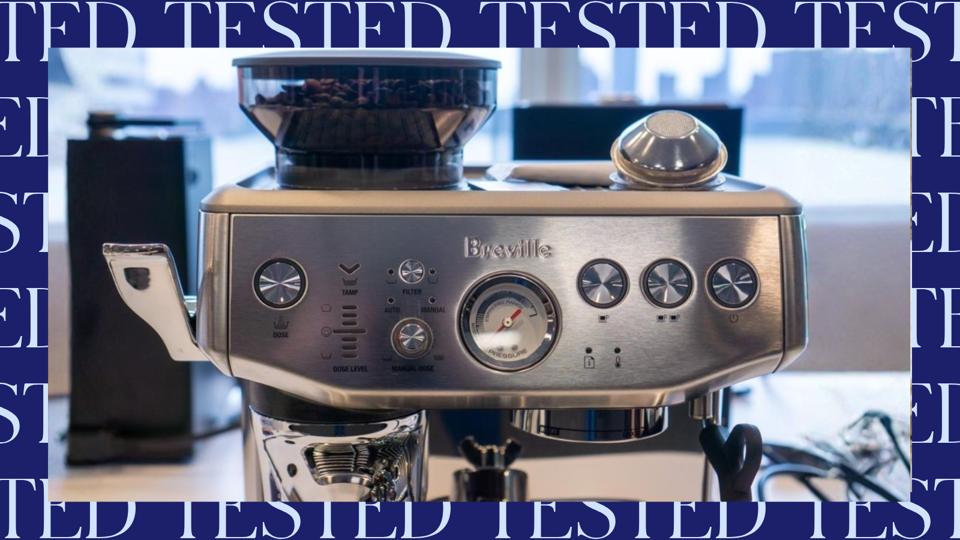


With its premium construction, user-friendly design, mess-free operation and rich flavor yield, the Breville Barista Express Impress is the machine we’d recommend to most people starting out. Our tester lauded it for its intuitive qualities; they particularly appreciated that “almost the entire process can be automated” and that the machine “did most of the work” for them to produce a solid shot. The machine includes all of the accessories you could possibly need for a good brewing experience, with a convenient storage drawer built in to organize these tools when not in use.
This semiautomatic machine has a bevy of helpful features, starting with a built-in conical burr grinder with 25 settings. While you might have to experiment a bit to determine the right grind setting, the machine’s smart dosing system measures the perfect amount of beans to grind for your chosen drink, and the assisted tamping enables you to simply pull a lever to tamp the grounds with a consistent and ideal amount of pressure every time. Then, during brewing, a thermocoil heating element works quickly to power the machine.
Above all, our tester liked how straightforward this machine was to operate, followed by how simple it was to clean. The water tank is easy to pull out, carry and refill, and there are several removable plastic parts that can be seamlessly taken out and cleaned by hand once you’re done. (No parts of this machine are dishwasher safe.)
On the topic of overall drawbacks, there are a few, but they’re not necessarily dealbreakers. Despite the machine’s generally intuitive features, our tester struggled to adjust the brewing temperature on it to improve the extraction and flavor of their shots. Besides this, they found that a single assisted tamp was not enough produce a robust enough extraction, and regularly had to tamp it twice.
Speaking of extraction, the shots were slightly but consistently underextracted—a little thin in texture and not as sweet and rich as they could be, but not unpleasant tasting—despite several adjustments to the grind settings and attempts to weigh, dose and tamp the espresso manually. That said, some of this may be due to the fact you can’t adjust the pressure of this machine to fine-tune extraction, unlike some of the other models on this list, such as the pricier and more manual .
The 2026 Forbes Vetted Best Product Awards are here: Explore our 150 top-recommended items across categories after extensive research and testing.
While Craig Deahl and David Roa, cofounders of Superlost Coffee (whom we spoke to for this story, and whose beans we used during our testing) generally recommend semiautomatic espresso machines between $700 and $1,000 for their balance of quality, price and essential features to control the brewing, there are some promising ones that fall below that range—notably, the Breville Bambino, which they called out specifically.
While its a decent espresso maker, the Bambino’s affordable price equates to fewer features, giving you less control over your espresso drinks than other picks on this list. For one thing, you can’t adjust temperature or brewing pressure to dial in your shot; in fact, there is no pressure gauge on the machine at all. Furthermore, the milk steamer has a simple “on/off” button instead of a dial, though our tester (who has some espresso-pulling experience) had no issues with the functionality.
The Bambino requires a little more elbow grease than the ,but it’s overall straightforward and intuitive to use: Simply grind your beans, fill your portafilter and tamp the puck, re-insert it into the group head and press a single button (selecting one shot or two shots) to brew. The automatic shot stopper then times the brew based on the volume you select, with a pre-infusion period built into each cycle. You can re-program the machine to time the brewing cycle according to your preference, or you can operate the machine manually. Again, the manual milk steamer is activated with a single button, meaning you can’t adjust the force as it works. (If you’re not as confident in your milk steaming abilities yet love cappuccinos, Breville offers the upgraded , with an automated steaming wand, for about $200 more.)
While the Bambino has a lot going for it, it doesn’t feel quite as high quality as some of the other options on this list: In particular, the tamper and portafilter felt lightweight and flimsy. But overall, it’s an easy-to-use, budget-friendly pick that consistently made great-tasting espresso during our tests.
The Profitec Go was our favorite of the prosumer single-boiler machines we tested (that is to say, it’s a machine made with professional-quality parts for the at-home user, and it has a single heating element to power both the brewing and steaming mechanism). While it’s plenty user friendly, the machine is also a powerhouse: It heats up in about 7 to 9 minutes, which is considerably faster than other similar machines typically requiring twice the heating time, and can switch from “brewing” to “steaming” mode in about one minute, which our tester found equally impressive.
While working with the Profitec Go, our tester appreciated the machine’s externally adjustable brew pressure, which is a unique feature that only a few machines in this price range have; they noted this was complemented by the machine’s reliable PID temperature controller, which, when our tester took measurements during testing, kept the boiler steady throughout the brewing process and led to the most even extraction in each shot they pulled. Being able to control these variables makes it so users can quickly and seamlessly dial in their shots and produce the best espresso possible with any bean type or roast level.
This machine is considerably more manual than the , and even the : You need to grind, dose and tamp your beans on your own, and there’s no automatic shot stopper, so you have to click the “brew” button again to stop the process once you’ve gotten the volume of espresso you’re looking for. Cleaning this machine is a bit of a manual process, too. There is a “Cln mode,” which alerts you when the group head needs to be attended to, but you need to run a backflushing cycle yourself to do the job. Similarly, using and cleaning the steam wand is a manual process, but an easy one: To do either task, simply twist the valve open to your desired level when the machine is in steaming mode.
Aesthetically, the Profitec Go was the most visually striking espresso maker we tested: Its brushed stainless steel exterior comes in three vibrant colors (light red, light blue and yellow) plus two more-traditional hues (black brushed stainless steel and traditional stainless steel). It’s a fairly compact device and can easily fit under standard cabinet heights, but its size brings with it one of the only drawbacks we experienced: Our tester noted that “the limited space beneath the group head barely accommodates an espresso cup, even with a thin scale.” Once you dial in your machine, though, your reliance on that scale to measure output may be reduced, and the narrow cup clearance may be less of a concern.
The Breville Oracle Jet surprised us during testing, in the best possible way. Most experts recommend that serious espresso drinkers invest in a separate, espresso-specific grinder and a food scale to grind and dose your beans; per Deahl and Roa, this lets you fine-tune your dial-in process more easily when you’re working with a new bean, and makes the diagnosis and repair process slightly easier should anything break. But the Oracle Jet—which has an integrated conical carbon-steel burr grinder from the family of products, with 45 settings—produced reliably good coffee during our testing. Between its grinding abilities and versatile features, this model in particular would benefit households with users who have different skill and comfort levels with their espresso-making craft.
Like the , this model has a smart dosing system, and it yielded remarkably consistent results when we weighed the output to verify accuracy. The auto-tamping system, meanwhile, worked better than the Barista Express Impress’s assisted tamping setup. Heat-up time was fast, as well, powered by Breville’s proprietary ThermoJet heating element and heated group head. And while brewing temperature can easily be controlled in one-degree increments to help you dial in your shot, machine pressure can’t be adjusted.
The machine has a big and bright touch-screen display that guides you through the extremely straightforward setup process. It also lets you easily adjust output, milk foam texture and machine temperature, select pre-loaded drink recipes and run a cleaning cycle to flush out the machine. Beyond this, the display is where you get feedback on the drink you create after you brew it, telling you if the shot you pulled ran too fast or slow and offering suggestions for how to improve it next time.
While the Oracle Jet is sleek and surprisingly compact for all of its included features (it also has the brand’s signature hidden accessories drawer), it’s 17 inches tall, so fitting it underneath a standard cabinet height may be slightly tight. It’s also got a roomy water reservoir integrated in the back of the machine, so you need enough counter depth to be able to pull it out and replace it—though if you’ve got some clearance above your machine, you can utilize the handy front-fill spout on the top. While it’s primarily made of stainless steel, it does have some potentially breakable plastic parts that gave us pause for a machine at this price level (for reference, it’s more expensive than the all-metal and much sturdier-feeling ), and the portafilter in particular felt a little lightweight. Overall, though, it’s a reliable and impressive model that held its own against the other high-end contenders we tested.
For espresso hobbyists who want a premium machine that’s as close to professional-grade as you can get at home (aside from the La Marzocca or , which are two to three times the cost, respectively, and infamously tricky to maintain), the Rancilio Silvia Pro X is a model that we highly recommend.
The Pro X is the only dual-boiler machine on this list, meaning you can pull shots and steam milk simultaneously. We noted that the total heat-up time for both boilers is about 15 minutes, which is pretty quick considering the two heating elements’ large capacity. The PID display (which doubles as a shot timer—same as the ) is clearly visible, and allows you to adjust the machine’s temperature settings for brewing and steaming in one-degree increments.
You can also use the PID display to activate automatic wake-up and shut-down times for the machine, program your desired pre-infusion length (where water saturates your grounds at a low pressure before brewing it, often leading to a more evenly extracted shot) and drain the boilers. Pressure is technically adjustable on the Pro X, but you need to open up the casing and do this manually in the back of the machine. (You probably won’t have to tackle this often, if at all, though.)The steam wand is also fast and powerful, turning cold milk to textured microfoam in around 12 seconds. Aside from the brewing and steaming functions, there’s also a dedicated hot water dispenser wand and activator button, too.
The heavy-duty build on the Pro X is a sign of its quality and durability: It’s the weightiest on this list, thanks to its all-metal components. The portafilter, too, feels substantial and solid in hand—so much so that our tester joked that “it may end up as a murder weapon in the next Clue movie.” While the drip tray is height-adjustable to accommodate cups of different volumes and a scale, it’s rather shallow and cumbersome to remove and empty. Speaking of awkward design, the pressure gauge is small and displayed in a strange place—on the front of the machine but underneath the group head—and ends up being somewhat obscured while you’re brewing. This wasn’t at all a deal-breaker during testing, though.
“Fully automatic machines are excellent for beginners who want a delicious coffee that they don’t need to think about too much,” says Tommy MLarney, New York-based trainer at La Colombe. “These machines grind and dose coffee internally, simplifying a user’s involvement to pushing a button.” Based on testing, we think the newly launched De’Longhi Rivelia—which makes 18 drink types, from standard espresso to cortados to cold preparations—is the best of its kind.
Despite its mostly plastic exterior, the Rivelia is an attractive-looking machine, and its slim profile makes it a great fit for even smaller kitchens. It’s also a breeze to set up. We liked that there are two interchangeable hoppers, so you can easily switch out your beans in case, for instance, you drink decaf in the afternoon. The milk carafe plugs into the front of the machine, and the easily refillable (though not super roomy) water tank sits on the right. The conical burr grinder in the machine does have 13 settings to adjust fineness, and if you’d prefer to use pre-ground coffee, there is a separate receptacle where you can add that in.
The digital display is extremely intuitive to use, and is situated on the top of the machine (instead of the front, like the other fully automatic machines we tested). If you have higher countertops, this may be a nuisance, but it worked well for our average table height. When it came time to brew, our tester found the flavor was balanced and the texture was “not too thin and not too syrupy,” with a “lovely and velvety” crema produced on top. The temperature of the shots we pulled stayed consistent every time we used the machine, and a double shot poured at exactly 38 grams, which was right on the money.
Users can adjust the strength, grind size and total volume of each drink they prepare, and then save these settings for future brews. What’s more, up to four people can create “profiles” on the Rivelia where they can populate their preferred drinks. Cup clearance is good to accommodate different glassware, and the single brewing nozzle on the front can be adjusted in height based on the drink type and glass size.
Like the other fully automatic machines we tried, the Rivelia has a super-simple cleaning mode that flushes out the brewing and milk carafe nozzles. The milk system is automatically cleaned after every use, but you may want to disassemble it more fully and wash individual parts on occasion. The machine tells you when to descale, so you can run a cycle accordingly when you get that indicator on the digital display. The grounds container and drip tray also need to be attended to manually; you get a notification about the grounds container on the digital display, and a small red tab projects up from the drip tray when it needs to be emptied.
Other Espresso Machines We Tested
We tested nine other models that didn’t make the final cut. Six earned high enough scores that we’d recommend them for specific uses, and three didn’t earn our approval.
Espresso Machines We Tested And Recommend
- : We liked this model, which is in the Breville family of products. While it felt a little less sturdy than other prosumer machines we tested, it has a reliable PID temperature controller that allows the user to further fine-tune temperature on the digital screen. Cup clearance was the most generous of the machines we tested, and could accommodate even a latte glass stacked on top of a scale. We did have some trouble with the machine’s pressure gauge during testing, but it still managed to pull some very delicious shots.
- : The all-metal build on this semiautomatic machine is solid and, with a little work, it produces some great-tasting espresso. That said, its lack of PID temperature controls and very narrow cup clearance took it out of the running, especially when compared to the Profitec Go.
- : This cult-favorite machine is powerful and affordable, and diehard fans tend to upgrade it, most often adding a PID for temperature stability. However, it fell into a bit of an awkward place in our testing—not as user-friendly for beginners or people on a budget as the Breville Bambino, and not as high-performing right out of the box as the Profitec Go.
- : This semiautomatic machine is built like a tank: Despite being the brand’s most compact model, it was one of the tallest, heaviest and bulkiest machines we tested. Additionally, its warm-up time was on the slower end due to the machine’s larger-than-average boiler, but its externally adjustable temperature (regulated through the PID display) and pressure were nice touches. We did really enjoy this machine overall—we just preferred some of the others we tried.
- : This budget-friendly machine impressed us with its quick heat-up time, PID temperature controller, visible pressure gauge and powerful steam wand that belied its petite size. That said, the steam wand was not very easy to move around and stuck a lot when we tried to adjust its positioning, and the portafilter was also hard to muscle into place. Besides that, it was unexpectedly difficult to dial in our shots properly, and we had to tinker with grind size and tamping quite a lot.
- : This fully automatic machine produced great-tasting espresso and buoyant, creamy microfoam, and it was dead-simple to use. That said, we had a ton of trouble with the milk carafe and its connector hose and found that the cup clearance is limited for taller glasses and mugs.
Espresso Machines We Don’t Recommend
- : This fully automatic—and beautifully designed—machine innovatively applies the powerful technology of a smart appliance with the careful craft of espresso brewing. We were hoping to like this one, but the brewing temperature was pretty inconsistent each time we pulled a shot, and right out of the box, the device produced pretty overextracted and bitter espresso.
- : Unfortunately, this machine underwhelmed us in both the frustrating lack of user-friendliness of some of its features, like the automatic grinder, as well as the low quality of espresso it brewed, no matter how much we tinkered with it.
- : Similar to the Specialista Arte, the espresso that this machine produced left a lot to be desired—it was the worst tasting in all of our testing, and consistently overextracted and bitter. In our opinion, it’s worth spending a little more on a model like, say, the Bambino, to get a much better result.
How We Tested The Best Espresso Machines
To determine the most impressive espresso machines in 2025, we consulted coffee experts to get their insight into models designed for home use, researched top-rated picks from popular brands and road-tested over a dozen ourselves.
Initial Research, Expert Consultation And Shortlisting
We looked into best-selling models from trusted kitchen brands like Breville, Rancilio, Gaggia, Profitec, De’Longhi and more. When researching models, we considered a number of factors, like each machine’s functionality, footprint, ease of use and cleaning, additional features and accessories, water tank capacity and warranty, among other criteria. We also pored over user reviews and ensured that everything we placed on our testing shortlist earned at least four out of five stars from purchasers across retailers.
As part of our research, we spoke with four coffee professionals to get their guidance on what makes an ideal espresso machine for the home, and took their advice into consideration when developing a shortlist of models for testing. We also asked for these experts’ insights on how to pull a great shot, including the right tools for the job, the right beans and grind setting to start with and the proper technique for dialing in each machine. With this information and our research in hand, we narrowed down our list of 50 machines to a svelte 15 to test firsthand.
In-Person Panel Testing
Joined by two of our consulted experts, Deahl and Roa, a panel of five Forbes employees with varying levels of expertise with espresso brewing then tested our shortlisted machines to evaluate the following criteria:
- Overall design (appearance, construction, dimensions, weight, cup clearance, water tank capacity, quality of materials, noise)
- User experience (ease of setup and use, learning curve required, how often the water tank needed to be refilled, or the drip tray and grounds container needed to be emptied)
- Machine temperature and pressure consistency throughout the brewing process
- Extraction level, consistency, quality and flavor of shots pulled
- Power of steamer and texture of microfoam produced
- Ease of cleaning
Using Superlost Coffee’s beans, ground with both the and grinders, we pulled more than 15 double shots from each machine, amounting to more than 200 in total for the day, and made 4 or more milk drinks from each (at least two with whole dairy milk milk and two with full-fat oat milk each).
We tested in the Forbes offices in Jersey City, New Jersey, where the water is rather hard; most machines came with a filter of some kind to abate this, but we made sure to add filters into any ones that didn’t already come with a filtration system.
If the machine had a built-in grinding, dosing and tamping system, we prepared shots using all of those included features to gauge their effectiveness. We also prepared “control” shots side-by-side shots from those same machines with an independent set of tools—the Baratza or Fellow grinder, , and . We measured brew temperature using a digital thermometer, and on machines without dedicated shot timers of their own, timed shots with our smartphone stopwatches.
After pulling our shots, we backflushed the machines or ran an automated cleaning cycle (if applicable) to gauge how easy it was to use and how effectively it cleaned the machine. All removable parts were then removed and washed by hand in the sink.
How To Shop For An Espresso Machine
Shopping for the right espresso machine for you starts with a few important questions: How much control do you want to have over the brewing experience, how often are you using your machine and how much are you willing to spend? Then, you’ll want to use that information—plus other considerations, like any special features and accessories that come with the machine—to home in on the model you ultimately buy.
Machine Type
There are three main types of espresso machines: Manual, semiautomatic and fully automatic (otherwise known as superautomatic).
- Manual machines: These types of espresso machines are the most involved. You’ll grind your beans, weigh your dose and tamp your puck, heat your water to the optimal temperature using a separate kettle, and engage a lever on the machine to exert the correct level of pressure over a precise period of time to pull your shot. Some of these machines can connect to a power supply for preheating purposes, but many don’t.
- Semiautomatic machines: These are the most common and popular type on the market. They typically automate elements like brewing pressure and temperature, but within the semiautomatic category, you can find machines that do the lion’s share of the work for you: grind, dose and tamp the beans, extract your shot using automatic presets for brewing temperature, pressure and timing, then steam the milk into airy microfoam.
- Automatic machines: These give you the least control over your finished product, but do absolutely everything for you. You’ll just fill the water tank and milk carafe, add coffee beans (or pods, in the case of machines like Nespressos) and press a single button to yield your drink. Press another button, and the machine will self-clean. The sheer convenience factor is the biggest selling point for models like these.
Heating Element Type
Semiautomatic espresso machines with single boilers, like the , hold and heat a large volume of water to power the brewing and steaming process—typically separately. Depending on the size of the boiler, these models often take between 15 and 30 minutes to heat before you’re able to start using them, and often need a “break” to refill and reheat between rounds of shots. Some machines, like the , have two boilers; they work in much the same way as single-boiler machines, but have two heating mechanisms so you can brew espresso and steam milk at the same time.
Machines with a thermoblock, on the other hand, feature a block-shaped piece of metal with a pipe running through it. These can heat up extremely quickly, in about a minute, and require no “recovery time” like boiler-powered machines. Many of the Breville machines on this list, like the , are heated with a thermoblock. This technology is often lower-cost to build, and so the machines powered with it tend to be a bit more affordable, too. They also take mere moments to heat up for maximum convenience.
Features And Accessories
Some of the most common add-ons you’ll see, particularly on semiautomatic machines, include a bean hopper and burr grinder with customizable grind settings; regulated temperature control (often times via an algorithm called a PID—which stands for proportional integral derivative—that, in a nutshell, keeps brewing temperature steady throughout the process); a steam wand with some level of power customization; a digitally displayed shot timer and automated shot stopper; a self-cleaning cycle of some kind; and on some machines, automated dosing and tamping capabilities to make sure the extraction level is just right.
By no means do you need the majority of these features, and in fact, espresso purists typically prioritize just one of them above all: the PID. And on the flip side, all four experts we spoke with recommend deprioritizing one of them in particular: the built-in grinder. This is because you can get a much better level of control on your grind size with a separate machine, and face less risk of having to replace or repair your whole machine if the built-in grinder breaks.
Price
When it comes to espresso machines, there is somewhat of a correlation between the price you spend and the consistency and reliability that follows—though we found the to be a notable exception to this rule. Deahl and Roa, two of the experts we spoke with, suggested that roughly $700 to $1,000 is the price shelf most consumers will want to look for in a semiautomatic machine to get a good balance of quality and affordability. At this range, you can expect a machine with a high-quality and sturdy stainless steel construction, a good number of configurable features (like a dozen or more grind settings, if a grinder is included on the machine, plus adjustable pressure and temperature settings, oftentimes using a PID controller) and some included accessories (like a hefty tamper and steaming jug).
Materials
Externally, most espresso machines are built with some combination of plastic and stainless steel; as a rule of thumb, the less plastic your machine is built with, the less likely any of its parts will crack or warp. As for the inside, if you’re looking for a machine powered by a boiler, you’ll often find them made of aluminum (often made and sold at a lower cost) or brass (slightly more expensive but with unparalleled thermal conductivity).
Why Trust Forbes Vetted
The Forbes Vetted home team has researched, written and published dozens of articles on the best kitchen appliances and products available online.
- Our team has also evaluated the best coffee makers, cold brew makers, coffee grinders and even coffee subscriptions.
- Author and former senior editor Amanda Arnold, participated in testing and edited this story and leaned on her past experience as a barista. Coauthor Brinda Ayer, Forbes Vetted’s editorial director with yeras of experience as a kitchen editor, organized and participated in panel testing for this story to determine the winners on this list and contributed reporting.
- We regularly review this story for freshness. It was last updated in March 2026 by Claire Epting, who specializes in updating Forbes Vetted’s lifestyle content.
Our Experts
- Tommy McLarney, New York-based trainer at
- Craig Deahl and David Roa, CEO and CPO of , a Brooklyn-based roasting company