As opposed to manually operated pool vacuums, robotic pool cleaners work autonomously, using rotating brushes and powerful suction to lift and collect debris. Our home editors consulted with pool maintenance experts and analyzed dozens of top-rated options to find the best robotic pool cleaners of 2026. Our winner for the best robotic pool cleaner overall is the expert-recommended , which works on a wide range of pool surfaces. For in-ground pools, the effortlessly climbs up walls and effectively sucks up medium-sized debris. And if you’re looking for an affordable cordless option, the features a 180-minute runtime and app integration and excels at cleaning walls and uneven surfaces.

The Hayward SharkVac XL is a powerful and versatile pool vacuum that’s suitable for most people. It’s compatible with pools up to 40 feet long and cleans the walls, coves and floor. Beyond that, though, the robot can climb all the way up to the tile line where grime and bacteria can accumulate—differentiating the Hayward from less premium models.
Efficient And Methodical Cleaning
Once you place this robot in your pool, it uses smart steering technology to plot a methodical route that’s calculated based on its size and shape. According to the brand, the SharkVac XL also uses up to 94% less energy than traditional suction-side and pressure-side vacuums—its energy efficiency, combined with its effectiveness, is one reason pool service expert Joe Costello regularly recommends this model to his clients.
Features Two Fine Filters And Protective Sensors
The XL model of the SharkVac is also particularly noteworthy for is its out-of-water and beach-entry sensors. These prevent the vacuum from running out of the pool to protect its motor from water, helping it run as efficiently as possible. The cleaning cycle takes just two to three hours, and when it’s time to clear the debris and rinse the two fine-porosity filters (which can trap particles as small as 5 microns like silt), it’s easy to access them right on top of the unit, though some reviewers note that the lid itself can be tricky to open. If your pool tends to accumulate a lot of larger debris like dirt, pollen and leaves, it’s worth noting that you can buy Hayward’s optional for about $23 for a pair so your finer filters don’t clog.
This particular bundle includes a caddy so you can transport and store the SharkVacXL easily. And speaking of storage, other users note that the plastic handle can fade over time, so if that’s important to you, make sure to store it properly when not in use.
The Dolphin Nautilus CC Plus’ “plug-and-play” functionality means all you have to do is plug it in using the 60-foot cord and drop it in the pool. It takes about two hours to clean most pool surfaces and shapes. What sets this cleaner apart from others is its connectivity with the MyDolphin Plus app and its smart navigation. The latter is a feature that John Uhle, product expert at Discount Salt Pool, highly recommends for full cleaning coverage if you own an in-ground pool—“especially those with deep ends, steps or unusual shapes,” he says.
An Optimized Design And Helpful Wi-Fi Features
Furthermore, the app helps you schedule cleanings so you always come home to a clean pool. Note that while these app features are incredibly useful, you don’t get functions like the ability to manually steer your robot pool cleaner or choose from multiple cleaning cycles, like you can with more advanced (and more expensive) models like the Dolphin Premier, our top pick for walls. But if you only need those core app features, the Nautilus CC Plus is a great value.
Besides its Wi-Fi capabilities, this Nautilus CC is ideally equipped to tackle most pool floor types due to both its dual scrubbing brushes and a suction power of 4,500 gallons per hour (gph). The brushes are made with both PVC and foam, allowing the robot to tackle both slippery and textured surfaces. Meanwhile, according to Uhle, tile surfaces are best tackled by robots with 4,200 gph or more of suction power.
Filtration And Maintenance
The Nautilus CC Plus also has an easy-access, top-load fine-porosity filter that requires only rinsing with a hose. Note, however, that like the Hayward, this unit only comes with one fine mesh filter. Dolphin offers optional for around $23 if you’re looking to tackle smaller particles like fine sand and silt. Another thing to bear in mind: When the unit has finished cleaning and is ready to be picked up out of the pool, you need to be able to support its weight full of water (which can reach upward of 36 pounds) for a few seconds while it drains. That said, it does feature an easy-to-grasp handle to assist with this task.
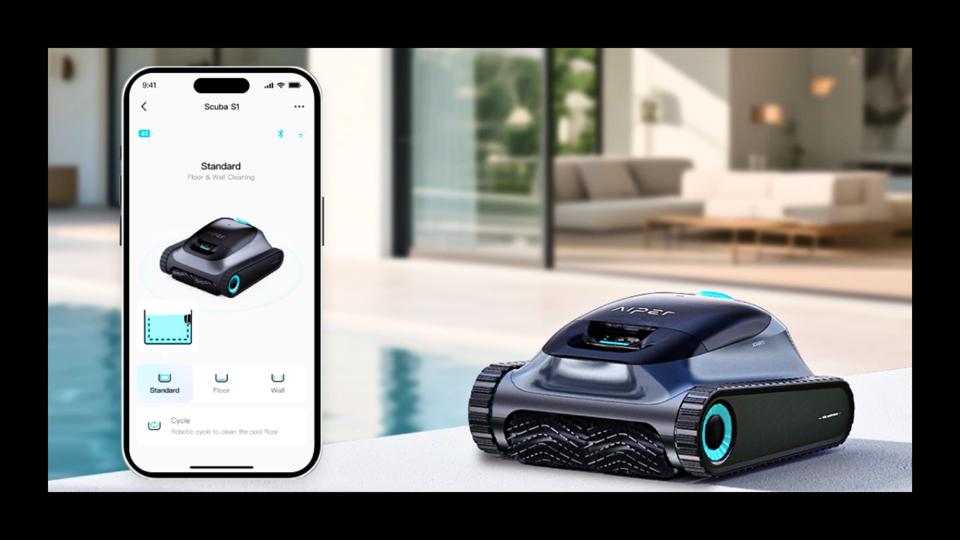
The Scuba S1 is the best choice for a user-friendly, cordless pool vacuum. Weighing under 20 pounds, it effectively cleans all types of debris from the floors, walls and waterline. It’s made by Aiper, the pool robotic cleaner brand that’s garnered Reddot and CES Innovation awards for its intelligent machines. It’s also one of the company’s most affordable models—at just under $500 on sale, it’s priced well below our top pick for smart navigation, the .
Navigation And Performance
First, at 16.5 pounds, this unit is one of the lightest picks on our list. At about 7 pounds lighter than our other smart pick, it’s easier to fish out of the pool once it’s done with its cleaning cycle (though note that with a bin capacity of 3.5 liters, it’ll be significantly heavier when full). It also uses WavePath Navigation, a unique technology that moves the robot in an N-shaped pattern for a more systematic, efficient cleaning cycle. Another noteworthy feature is the “caterpillar” treads (instead of wheels), which helps with the robot’s traction while cleaning walls and other uneven surfaces. And its filter cartridge is top-loading, simplifying cleaning and maintenance.
Model Upgrades Add Convenience
The most important thing about the Scuba S1 is its pool-cleaning prowess, making it a great value at its current price point. Aiper has made several improvements that have helped land this machine on our list. Compared with the old version, the current Scuba S1 features a longer runtime of 180 minutes (30 minutes more than before), an improved smart navigation system and an extra 3-micron ultra fine filter for capturing smaller debris. Another improvement is its convenient connection to the MyAiper mobile app, which lets you schedule cleanings, access firmware updates and monitor water quality.
Pool robot vacuums already promise greater convenience and time savings when it comes to maintaining your pool, but the Beatbot AquaSense 2 maximizes those benefits even more. That’s because it’s not only cordless, but it’s also equipped with smart navigation, obstacle avoidance, a four-hour runtime and four powerful motors.
Thorough Navigation And Noteworthy Smart Features
The AquaSense 2’s mapping technology is where this robot truly shines. It optimizes its path using 16 precision sensors, two of which are responsible for obstacle detection. It also uses an S cleaning pattern for floor cleaning and an N-shaped path for the waterline and walls, making it less likely to miss corners, especially in irregularly shaped pools. And its smart features go beyond mapping: When a cleaning cycle is done (or when the battery is low), the machine floats to the pool’s surface and “parks” there so you can fish it out. Beyond the floors and walls, it can also scrub the waterline—and does so twice with each pass for a more thorough cleaning.
Another highlight: The AquaSense 2’s particularly high suction rate of 5,500 gph, compared with the ’s 4,200 gph and the ’s 4,500 gph. This power, combined with the robot’s thorough and precise cleaning, makes it uniquely equipped for pools larger than 3,000 square feet. The only downside of this powerful and precise robot pool cleaner is that it can’t skim your pool’s surface, which at this price range might be something shoppers expect. If this is important to you, the has this feature—but costs about $1,000 more.
A Lengthy Runtime And A Dual-Layer Filter
While a common knock against cordless robot pool vacuums is the need to recharge them in the middle of a cleaning cycle (especially if you have a large pool), this particular model can clean floors without stopping for four hours—three and a half hours if it’s also scrubbing the walls and waterline. The AquaSense 2 also uses a dual-layer fine filter, which can capture debris like leaves and smaller particles like sand, all the way down to 150 micrometers; just note, this robot lacks an ultra-fine filter, which helps clear cloudy water of finer particles. This two-layer design helps keep the robot’s suction strong and even by preventing the filter from clogging too quickly with larger debris.
Other features we like are the included hook so you can easily fish it out from the surface of the pool, its automotive-grade IMR coating that helps protect its parts from the sun and the fact that it charges wirelessly. Plus, the AquaSense 2 is backed by an uncommon three-year warranty.
The Dolphin E10 is equipped with the same baseline functionalities of the brand’s more premium robots: a plug-and-play functionality, an easy top-loading filter and smart navigation. For owners of small above-ground pools, those new to robot cleaners or those who want a no-frills model for their pool floors, this lightweight, under-$600 machine fits the bill.
Only Cleans Floors, But Cleans Them Well
While the E10 is only optimized for cleaning floors of above-ground pools up to 30 feet, it does this particular task quite well: Reviewers say its rubber tracks and scrubbing brush, which spins at twice the speed of the robot itself, work efficiently and thoroughly during the 90-minute cleaning cycle. If your biggest concern is the debris that tends to settle on pool floors—such as leaves, dirt and sand—the E10 has a suction power of 4,000 gph and a fine-filter basket that make it more than capable of the job. If you want the ability to capture finer particles like silt and algae but don’t want to spend hundreds more on a more advanced robotic vacuum cleaner, there’s an optional you can snag for about $45 that’s compatible with the E10.
Despite its affordability, The Dolphin E10 is also equipped with smart navigation software that scans your pool floor to find the most efficient cleaning path for maximum coverage. This particular technology is crucial because of the E10’s comparatively short runtime of 90 minutes—in other words, it doesn’t waste time going over the same spot twice. As a bonus, the E10’s sensors can detect pool features like walls, ladders and drains, too, adding to its cleaning efficiency.
Great For First-Timers
Like the more advanced , the E10 is a plug-and-play device, making it well suited to first-timers. All you need to do to use it is to drop the robot into your pool, plug it into your power outlet and press a button. It also only weighs about 14 pounds, one of the lightest robots on this list. This, combined with the easy-to-access top-loading filter and the speedy water-draining feature, makes it easier to fish out of the pool and clean after a cleaning cycle.
While it does have some limitations compared with other models (it doesn’t provide an anti-tangle swivel feature on its cord, for instance), the E10 is made by a brand with a solid reputation for thorough pool cleaning. It’s a highly energy-efficient device that only adds a few dollars to your energy bill every month, according to several reviewers. If you’re looking for a lower-priced model, this is a better choice than products made by lesser-known brands.
While this is one of the smallest and most affordable offerings from Dolphin, the Nautilus Pool Up still features powerful commercial-grade motors with a suction power of 4,500 gph, which allows it to do a thorough job of both cleaning floors and scaling and scrubbing walls. With its 30-foot limit, the Pool Up can clean most smaller pools in two hours.
Powerful, Thorough And Smart Cleaning
Like Dolphin’s other robotic cleaners, the Pool Up uses dual scrubbing brushes made with both PVC and foam that spin at high speeds to tackle an array stubborn particles like dirt and algae from your pool floors and walls. Its aforementioned high suction rate, combined with its large-capacity fine-filter bag, means the Pool Up also does a particularly great job capturing larger debris like leaves and twigs. One downside, though, is that it’s bottom-loading, so you have to empty the robot upside down. Keep in mind that the filter only has one fine layer; if you want the ability to capture smaller debris, you can grab the optional for about $45.
The Pool Up is also equipped with the same smart and efficient navigation technology as the more basic Dolphin E10—it can systematically map your pool to find the most efficient cleaning path for maximum cleaning coverage, while its sensors avoid obstacles like bumps and drains. And the Pool Up is a step up from the E10 in that it can clean both in- and above-ground pools, as well as floors and walls.
Easy To Use, But Lacks Some Key Features
Like Dolphin’s other models, this is a plug-and-play machine with no extra setup, hoses or pumps to worry about. It also has a fast water-release feature so you don’t have to deal with the weight of a full robot for very long while you’re cleaning it. Still, it’s decidedly less high-end than the brand’s more advanced models: It doesn’t have a mobile app, so you can’t schedule weekly cleanings, remotely control it or get notified when the filter bag needs to be emptied. But it has an on/off timer, and for pool owners who want the simplicity of a simple power button, the Nautilus Pool Up does the job well.
While the Dolphin Escape can also clean smaller in-ground pools, it’s especially equipped to clean above-ground pools, thanks to its ability to clean pool floors of any shape. It also features tank-like rubber tracks, which give it enough grip to excel at cleaning a variety of surfaces, from vinyl to gunite, as well as avoiding getting stuck—this grip is something many units for above-ground pools in this price range don’t have. It has the same CleverClean smart navigation software as other Dolphin models, making it efficient and adept at avoiding ladders and other obstacles.
Energy-Efficient And Thoughtfully Designed
This model has two extra-efficient motors, using a mere 180 watts versus the typical 1,800 watts of comparable models. These motors, though, still make the Escape more powerful than many single-motor and/or battery-powered machines in the same price range.
This model wields a rubber scrub brush that spins twice as fast as Dolphin’s standard brush—and it’s also worth noting that most above-ground robot pool cleaners only have a nonrotating, standard-bristle brush. This means the Escape is remarkably effective at tackling stubborn particles like algae and biofilm that less equipped robot vacuums might skip over. Another highlight is this model’s ability to vacuum both backward and forward, adding to its efficiency and effectiveness, which is crucial considering its relatively short 90-minute runtime.
An Intuitive Plug-And-Play Unit With Some Misses
Like many of Dolphin’s robotic pool cleaners, this one is a plug-and-play model with a simple power button. This is a boon for those who want a no-frills model, but keep in mind that you don’t have a connected app to set weekly cleaning schedules. Another thing to note is that while the Escape makes the most of its 1.5-hour cleaning cycle, it stops wherever it is once that cycle is done—so if it’s in the middle of the pool, you need or another means to retrieve it. It also can’t clean walls, but this may end up being a small inconvenience for some types of above-ground pools.
Another common quibble among users is that this robot’s control box isn’t weather-proof, meaning you need to bring it inside or under cover when it rains. Last, while the top-loading filter basket is quite sizable—the brand says it holds 60% more debris than its traditional cartridges—you need to add optional (an extra $31) if you want to target smaller particles like sand and silt.
The Dolphin Premier’s commercial-grade dual motors are efficient, giving the model the power it needs to scale your pool walls. Its high-performance rubber tracks let it climb all the way to the waterline, which helps remove the considerable scum and biofilm that tend to accumulate in that area. Smart navigation ensures an efficient cleaning route, but you can also operate it manually with a remote control.
Powerful, Efficient And Targeted Cleaning
The Premier’s dual motors, specifically, only use energy at a rate of about 5 cents an hour, which can turn into quite a significant savings in the long term. And similar to the Escape, it has active dual-scrubbing brushes, meaning both brushes spin twice as fast as standard brush. This translates to a more rigorous scrubbing action that can tackle tough dirt, debris and algae. And its excellent waterline-cleaning abilities are owed to both the grippy rubber tracks and another feature missing in many other standard robotic vacuum cleaners: directional water jets, which help the Premier precisely target stubborn oils, organic growth and other debris at the tile line. Finally, similar to the other Dolphin robots on our list, the Premier is also equipped with CleverClean software, which intelligently maps your pool for maximum, efficient cleaning during its three-hour runtime.
Multi-Media Filter System Has A Bit Of A Learning Curve
This machine’s multi-media filtration is one of the reasons the Premier is so versatile. Uhle recommends different types of filtration for different-sized debris (e.g., a debris canister or coarse filter bag for leaves and twigs, or an ultra-fine filter for algae and sand). The Premier’s interchangeable filter options allow you to do both: ultra-fine nanofilters for silt and scum, and a generously sized leaf-collecting bag that can be dumped and rinsed. The machine also features indicator lights that alert you when it’s time to clear and rinse the filtration system.
All that said, the number of filters included—fine, ultra-fine and the leaf bag—can be overwhelming to a first-time robot user, particularly if you don’t know what type of debris or particles each one excels at capturing. Further, accessing the filter basket is slightly tricky because it’s located at the bottom, meaning you need to flip the vacuum upside down and manually unclip the filter bag, which can be extra-challenging with a full robot.
How We Chose The Best Robotic Pool Cleaners
To find the best robotic pool cleaners, we researched bestselling models from well-known brands and compared features, capabilities and reputations.
- We also dove deep into consumer reviews to recommend only the best-performing products.
- We tapped three pool maintenance experts to provide us background on robotic pool cleaners and inform our final selection.
- We compared offerings from top brands such as Dolphin, Hayward, Polaris and Aiper and narrowed our recommendations down to the very best in each category.
- We analyzed key features—including pool size and type, ease of use and cleaning, machine weight, filtration and cleaning run time—to assess overall value and help readers pinpoint the best option for their cleaning needs.
- We consulted reviews of each pool robot vacuum to ensure they are built to last, and we only recommended products with overwhelmingly positive reviews.
What To Look For In A Robotic Pool Cleaner
Pool robot vacuums offer plenty of benefits for pool owners—but due to these high-tech devices’ high price tags, it’s best to carefully consider a few factors to know you’re spending money on the right one. These include your pool’s size, shape, surface material, the type of debris that collects in it, maintenance and value. Ahead, our experts detail these considerations:
Pool Type And Size
Pools are either above- or in-ground, and robotic cleaners are optimized to clean either one or both types. Generally, above-ground pools are smaller and have a flat bottom, making them easier to clean and maintain. “[They] don’t require advanced navigation or extra-long cords, so a simple battery-powered robot may be enough,” says Uhle.
In-ground pools encompass a wider variety of shapes and sizes, including steps, deep ends and unusual kidney and L-shapes. For those trickier setups, Uhle recommends a pool robot with smart navigation: “Look for models with gyroscopic mapping or virtual pool scanning to ensure full coverage, including tight corners and steps,” he says.
For larger pools that span more than 40 feet in length, look for an extra-long cord of at least 50 to 60 feet for corded models. This allows the pool cleaner “to cover the entire area without needing an extension cord or having to reposition it,” says Scott Rajeski, the president and CEO at Latham Pool Products Inc. in Saratoga, New York. If you don’t have a grounded electrical outlet near your pool, though, you might consider a cordless model. In that instance, look for a device with a “battery runtime of at least 90 minutes to avoid leaving areas unfinished,” Uhle adds.
Pool Surfaces
“When selecting a robotic pool cleaner, it’s important to match the model to your pool’s surface,” Rajeski says, adding that robot pool vacuums particularly excel at the smooth contours of fiberglass pools due to their traction. Those with vinyl-lined pools may prefer robots equipped with soft bristles, he adds: “They provide a gentle yet thorough clean without risking liner tears or scratches.”
If your pool has rougher surfaces like concrete, pebble tec, stone or plaster, go for a more aggressive robotic cleaner with powerful scrubbers and extra features like power jets, says Uhle: “These lift algae and embedded dirt from textured or porous areas.” If your pool is tiled, it’s more likely to collect fine debris in its grout lines; in that case, “You will want a robot with high suction power of at least 70 gallons per minute (4,200 gph) and brushes that can reach into those tight spaces,” he adds.
Filtration
Robotic pool cleaners also have filter baskets, canisters or bags of different porosities and sizes. Examine what types of debris your pool typically collects to select which filtration system is best. For instance, if your pool is near trees or foliage and frequently collects large debris like leaves, twigs or petals, Uhle advises to “prioritize a model with a large onboard debris canister or filter bag.” On the other hand, choose an ultra-fine filter cartridge (ideally rated to capture particles between 20 to 50 microns) if you frequently deal with finer debris like pollen, sand, silt or algae.
He notes that some premium models have interchangeable filter cartridges: one for heavy debris and one for fine particles. Uhle suggests that, if you frequently encounter floating debris, you should look into adding a to your pool maintenance kit: “It patrols the pool’s surface, collecting leaves and bugs before they sink—something traditional vacuums can’t reach.”
Maintenance
One of the biggest advantages of owning a pool robot vacuum is that they’re generally easy to maintain, considering how much they contribute to keeping your pool clean. “Their independent filter systems reduce strain on your pool’s pump and main filter, which in turn lowers maintenance needs and chemical use,” says Uhle. These pool-cleaning devices tend to be built ruggedly, and with proper maintenance—namely rinsing the filter after each use to remove cleaning chemicals—they should last three to five years or more. Store these robots in dry, shaded areas to protect their sensors from the elements—although, adds Uhle, “Many models are designed to resist sun and chlorine exposure.”
Budget
As mentioned earlier, robotic pool cleaners cost a lot up front. They start at around $500 on the low end, and can get to upward of $2,000 as you add more advanced features. That said, they do end up saving you money in the long run; that’s because their motors are powerful but energy-efficient, says Uhle. “Their efficient motors use as little as 180 watts, compared to 1,500 watts for pressure-side cleaners. That’s up to 83% less energy used.” And they also don’t rely on your pool’s pump or filter system to operate, extending the latter’s lifespan.
That said, we recommend carefully assessing what added features you really need your robot to have before spending any extra money. Owners of smaller, above-ground pools and those who want basic cleaning functionality might not need more than just a plug-and-play model that only cleans the floor (and is at the lower end of these devices’ price range). But if you have a larger pool with high walls or a more unique shape, you might want to go for a pricier model with advanced features. “Higher-end models can often tackle all three areas.… If your pool tends to accumulate dirt and debris at its waterline, investing in a cleaner that can handle waterline scrubbing may be worth the extra cost,” says Rajeski. Other premium units also let you control them remotely or pre-program cleaning cycles. Rajeski’s rule of thumb: “Shop around to find a model that fits a happy medium between must-have features and your budget’s sweet spot.”
Why Trust Forbes Vetted
The Forbes Vetted home and kitchen team has extensive experience covering the best outdoor home products, including an expert-backed story on the best pool vacuums.
- Author Christine Colby is a seasoned product tester with years of experience testing and reviewing home-cleaning products. She’s recently covered the best self-emptying robot vacuums and the best carpet cleaners for pets for Forbes Vetted.
- Co-author Fran Sales is a home and kitchen writer for Forbes Vetted. She has researched, reviewed and/or tested everything from robot vacuums for pets to air purifiers in her five-plus years in commerce journalism.
- The Forbes Vetted home and kitchen section is overseen by deputy editor Rebekah Lowin, who uses her extensive experience in the home and garden categories to review and approve product selections.
- We regularly update our articles to ensure that every product featured is in stock, incorporates the latest information and remains the best in its category based on our experts’ criteria and customer feedback. This story was last updated in July 2026 by Sales.
Our Experts
- , a pool service and repair specialist with over 26 years of experience, and the owner of Aqua Solutions Pool and Spa in Saratoga Springs, Utah
- Scott Rajeski, president and CEO at Inc. in Saratoga, New York
- John Uhle, a certified pool operator and a founding partner and product expert at in Houston