and have a lot in common. Both are relatively new to the running scene, founded in 2009 and 2010, respectively. Each brand has developed a loyal following, thanks to standout models like the and the . They’re also known for their distinctive outsoles: Hoka shoes feature thick, foamy soles, while On Cloud uses large CloudTec “pods” designed to soften landings and improve takeoffs. In this Hoka vs. On Cloud guide, we break down how these popular brands compare, so you can find the right brand—and maybe even the right shoe—for your needs.
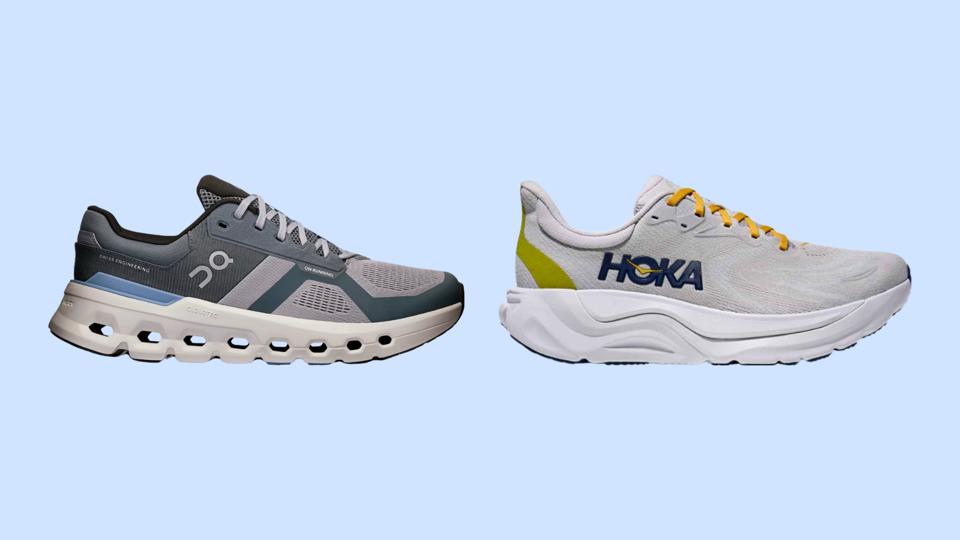
In many ways, the similarities between these brands can make it challenging to choose one over the other. But there exists just enough differences that it’s likely you’ll end up preferring one based on your body and your favorite activities. So, which is the better choice for you when the question is Hoka vs. On Cloud? Let’s take a closer look to find out.
Hoka Vs. On Cloud: A Brief Overview
As we’ve established, both Hoka and On Cloud are relatively new and unique running brands.
was founded in the French Alps, where trail running influenced its footwear. The brand’s thick soles were designed to absorb repetitive impact, with an emphasis on support and cushioning over unstable terrain. Today, the brand’s roster includes not only trail shoes, but road shoes, walking shoes, hiking shoes and so much more. Some styles still embrace the brand’s thick, signature cushioning; others are slim, light and built for speed.
was founded in 2010 by three Swiss friends who sought to create a road shoe that delivered soft landings and a firm takeoff. Runners at the time were a bit skeptical given the unique styling of On’s first shoe, but it didn’t take long for the design to receive the ISPO Brandnew Award, which recognizes groundbreaking products. Months later, On shoes were sitting on store shelves, and the rest, as they say, is history.
Before we move on, let’s clear up a couple of things. When Hoka was founded, the company was called Hoka One One, which many people pronounced as “won won.” In reality, it was meant to be pronounced “Own-Ey Own-Ey,” as the name comes from the Māori language and means “fly over the earth.” In late 2021, the brand shortened its name to simply Hoka.
As for On Cloud, the company isn’t actually called On Cloud—it’s just On. But its Cloud line of shoes became so popular that the name On Cloud unofficially stuck. To keep things simple (and avoid confusion), we’re rolling with it throughout this guide. Or running with it, if you will.
Hoka Vs. On Cloud: Cushioning
When it comes to the cushioning, Hoka reigns supreme. Its shoes were designed with trail running in mind, so best-selling styles feature grippy outsoles and chunky midsoles. This design once looked odd, but it’s quite common in the running world nowadays.
Most pairs of Hokas are maximally cushioned due to a thick layer of compression-molded EVA foam that compresses on impact and helps propel you forward with each step. “The shock absorption feature lessens the stress on muscles and joints,” explains Dr. Daniel Cuttica, a board certified orthopaedic surgeon with The Centers for Advanced Orthopaedics. “They are beneficial for those suffering from various foot and ankle conditions, such as plantar fasciitis and arthritis.”
Ironically, On Cloud’s cushioning comes primarily from a lack of cushioning, or empty space: The CloudTec cutouts in the soles of its shoes allow for impact absorption. When partnered with the foam material used to create them, the reduction is ample, albeit not as significant as you get with Hokas. But the pods do provide excellent propulsion as they regain their shape after each step.
Hoka Vs. On Cloud: Stability
"Stability” primarily refers to how a shoe supports your foot. Some shoes are specifically designed to prevent your foot from rolling inward as you step, which is known as overpronation. Pronating can lead to foot, ankle, knee and even hip and spine issues, so it’s important to correct it, if it’s a problem.
As it happens, both Hoka and On Cloud make shoes with stability features. Hoka adds stability through the use of a “J-Frame,” which is a band of thicker, denser foam that wraps around the heel and underfoot on the inside of the shoe. Similarly, On Cloud shoes add stability by using thicker and firmer CloudTec pods in the same place. These designs provide extra support to ensure your foot doesn’t roll as you step.
If you’re looking for a true stability shoe, the is a great option thanks to its “J-Frame” underfoot support, while the uses dual-density foam to create a similarly supportive experience.
Balance is also an important element of stability. “Hoka has a higher stack height than On Cloud, which helps with the plush maximalist design but also makes one higher from the ground,” explains Dr. Samantha Landau, a faculty member at New York College of Podiatric Medicine. “Some people find the shoes have reduced proprioception or ‘feel’ for the ground as they run,” so if balance is an issue for you, On Clouds may be the better choice.
Hoka Vs. On Cloud: Durability
Both Hoka and On Cloud shoes are highly durable, often surpassing the 300-mile mark that you should expect—at a minimum—from a good pair of running shoes. That said, the unique soles of each brand’s shoes will begin to break down not long after that point.
With Hoka shoes, wear and tear may be harder to spot due to the thick, cushioned soles. But if you notice your feet start rolling inward more than they used to, or if the foam feels a bit flat, it’s likely time for a new pair.
On Cloud shoes tend to show their age more visibly. The CloudTec pods may lose their shape, and that signature springy sensation in the midsole will fade. And if the tread has worn down to the point where you can see the foam underneath, it’s well past time to replace them.
Hoka Vs. On Cloud: Price
Price isn’t going to be a decisive factor when choosing between Hoka and On Cloud. Look through Hoka’s lineup and you’ll find that popular styles range from $100 to $200. The , for example, is $145, while the is $175. As for On Cloud, prices are similar. The is $160, and the , $170.
As tempting as it may be to shop for a cheap shoe, consider comfort, use case and style instead. Shoes sell for similar enough prices across both brands that it’s hardly worth trying to save money by choosing one over the other for that reason alone.
Hoka Vs. On Cloud: Which Is Right For You?
“Since they are tackling essentially different issues, Hoka and On are not competing for the same runner,” says Dr. Jodi Schoenhaus, DPM with the Foot, Ankle and Leg Vein Center. “Hoka provides treatment for a variety of ailments, including plantar fasciitis, sore knees and just spending too much time on harsh flooring.”
In aiming to maximize comfort, the designs include wide-fit alternatives, high-stack midsoles and structured support. “Comfort isn’t a luxury; it’s the main objective," Schoenhaus notes. "This explains why Hoka rules hospital halls and recovery runs alike. It’s a brand designed to increase endurance and absorb impact.”
On Cloud shoes, on the other hand, “combine elegance and performance with precision,” explains Schoenhaus. “The Speedboard plate and CloudTec pods sharpen the ride rather than make it softer. Every component of the design functions as propulsion, transforming it from a running shoe into a performance item that blends in perfectly with city life.”
On Cloud shoes were designed with a fast-paced, fashion-forward athlete in mind—someone who demands the same level of performance from their equipment on the road as they do on the track, or when simply strolling down 5th Avenue.
Long story short: Hokas are a great choice for more cushioning and support, especially if you stand on your feet all day, or have conditions like plantar fasciitis. And if you’re looking for trendy styles that look good and perform, On Cloud shoes should meet your needs.
Why Trust Forbes Vetted
The gear review team at Forbes Vetted has tested, researched and reviewed a wide range of footwear options over the years, including everything from technical sandals to walking shoes to hunting boots.
- This piece was written by Steven John, a staff writer with Forbes Vetted who runs multiple times a week, on roads, trails and treadmills, and who has tested dozens of pairs of road and trail running shoes over the years.
- The story was edited by Forbes Vetted gear editor Cam Vigliotta who has extensive experience testing gear and apparel, including footwear. His recent reviews include the Hoka Clifton 10 and Brooks Ghost 17.
- John spoke to several experts for this piece, including: Dr. Jodi Schoenhaus, DPM with the ; Dr. Samantha Landau, a faculty member at ; and Dr. Daniel J. Cuttica, a board certified orthopaedic surgeon with .
- Both Hoka and On Cloud regularly launch new and updated shoes, so we will periodically revisit and update this piece to be sure it contains accurate and relevant product information. It was first published in July 2025.